Inside you there are two wolves. They are extraordinarily small
wolves, obviously, in order to fit inside you, but they are otherwise
normal adult wolves of ordinary proportions. They are cuter than you are
imagining, because they are tiny wolves. They are less spiritually
magnificent than you are imagining, because they are yours. You can lead
a full and healthy life with only one wolf. Would you consider donating
one of your wolves to a stranger in need? Laparoscopic wolf extraction
is a minimally invasive medical procedure. Most patients recover
quickly, and long-term side effects are usually intangible. Note that it
is unlawful to give or receive monetary compensation for a wolf
transplant; however, you will be entitled to believe that your wolf will
receive karmic remuneration for its participation in this generous deed.
Your wolf yearns for release from saṃsāra. Any questions regarding this
procedure may be directed to anyone wearing a Three Wolf Moon t-shirt at
your local GameStop.
Keepsake preservation
When my father passed away several years ago, a family friend made
quilts out of his shirts. For a long time I kept mine packed away out of
sight. It seemed gruesome. Whenever I thought about it I’d get a feeling
as if my dad, with all his love and warmth and cheer and strength, had
been fed into some machine and this lifeless object had come out the
other side.
My aversion to the quilt faded with time, of course. Eventually it
became not just a keepsake that I treasured in theory, but also
one I might actually prefer to keep out and visible on a day-to-day
basis. But there was another concern that kept me from doing so: the
fear that the quilt would be damaged. I share my apartment with a cat,
and every piece of fabric he’s able to reach tends to get vigorously
scratched and rapidly coated in a thick layer of fur.
But a few months ago I decided it was absurd that many of the most
sentimentally-valuable objects I possess spend all their time in boxes
and closets. What a waste!
So I took the blanket out of the closet and kept it folded next to
the couch. It did become one of Pham’s favorite places to curl up and,
yes, it got a little scratched and a little hairy. But it’s the history
behind such objects that give them their value; accumulating more
history isn’t going to reduce that value. I decided that if, decades
from now, along with making me think of my dad, this quilt also makes me
think briefly of my cat, that’s quite all right.
…then I remembered there’s also the risk of Pham puking on
it and I put it back in the closet
Four phone frustrations
Getting notifications diverts my train of thought onto someone
else’s agenda.
Knowing that I haven’t gotten any notifications is also
distracting, if there’s one I’m waiting or hoping for.
The Internet in general, and infinite-scroll social media in
particular, constantly tempt me to procrastinate the boring or
frustrating parts of projects I care about and seek a quick dopamine hit
instead.
The unending supply of podcasts and audiobooks tempts me to pump
information into my ears continuously instead of leaving myself time to
think.
The obvious solution to these problems (and so many more!) is to
wander off into the wilderness and commune with nature until I get eaten by a
bear. But then who would make sure my cat gets his meds twice a day?
Plus it’s chilly outside and I hate being cold.
Anyway, I love the Internet. But even a great friend gets on your
nerves if they hang around 24/7. Smartphones keep us continuously linked
to a colossal, frenetic nexus of billions of minds. Sometimes that link
feels less like a lifeline and more like a tether.
Since my four complaints above all revolve around distraction,
willpower isn’t a great solution; consciously resisting the urge to
check my phone is also distracting. For me the most satisfying solution
is to leave the phone at home and go somewhere else. I’ve been doing
that a lot lately. Constant connection has become so normalized that
disconnecting for even a few hours now feels strangely indulgent; it’s
almost a guilty pleasure.
Sometimes I only want to be free of some of the distractions
of a phone while retaining other benefits. My impulse is usually to
solve this by buying more dedicated devices. In theory, for example, a
smartwatch should be a good way to escape the temptation of
doomscrolling but still get notifications, though I’ve never been able
to stick with wearing one for long. What I do find useful is having a
wifi-only Android device so I can listen to audiobooks or music on a
long walk without the Internet tagging along. At home I use a wearable
bluetooth speaker with physical back/forward buttons for a similar
purpose—I can clip it to my shirt and stow the phone somewhere out of
sight—though the urge to check notifications inevitably reasserts itself
sooner or later.
Be mad when people kill your enemies
Leftists on social media reacted to Charlie Kirk’s murder in a
variety of ways, ranging from horrified condemnation of the killer to
smug jokes about it. Some, without explicitly condemning or condoning
the killing, took the opportunity to declare that they weren’t going to
feel sad about Kirk’s death, because he’d spent his life pushing
dangerous and harmful ideas. I think this is a dangerously irrelevant
reaction.
Focusing on how terrible Kirk was or wasn’t gives the impression that
you’re OK with an individual unilaterally deciding to kill someone as
long as—in your judgment—the target deserves it. The more that way of
thinking is normalized, the more dystopian our society is going to get.
The more conservatives believe that we’re just going to shoot them when
they say things we think are dangerous, the more they’re going to feel
entitled to shoot us when we say things they think are dangerous. Where
do you think that process of escalating distrust and violence leads?
Isn’t it far more likely to lead to a bloody free-for-all or a
totalitarian takeover than to any sort of just and equitable regime?
(And who do you think is better-positioned to impose their will if we
start resolving all our major disagreements by violence—the party that
celebrates gun ownership or the party that frowns on it?)
No matter how you feel about your political opponents being
dead it’s in our collective self-interest to be strongly opposed to
them being killed. If you really think it’s important to
denounce someone’s politics right after they’re murdered, I’m begging
you to first denounce the murderer just as strongly. It’s the least you
can do to help keep the fragile threads of democracy from fraying
further.
One reason I’m writing about this is that I remember how I felt after
the January 6th riot, which—as a Biden voter—felt like an attempt to
nullify my vote and install the rioters’ preferred president by force. I
was disturbed by how undisturbed my conservative friends seemed to be by
that event. Perhaps they just felt no need to comment on it since they
were uninvolved; similarly, I don’t need to comment on Kirk’s
murder, since I had nothing to do with it. But in tense times I think
it’s helpful to explicitly reassure each other about where we stand on
these kinds of things.
I’d also like to remind my conservative friends that the most radical
voices aren’t representative of the average liberal/leftist. Just
because some edgelord on Twitter thinks political violence is a joke
doesn’t mean the Democrats in your neighborhood are gearing up to
massacre pundits. You don’t want to be judged for the most
unhinged thing any conservative says anywhere on the Internet,
either.
I’m glad that Democrat politicians like Bernie Sanders (here),
Gavin Newsom (here),
and AOC (here)
unequivocally condemned the murder.
🩶 review: Hollow Knight:
Silksong
it hurts in a good way
(mostly)
You awake on a bench. You dash through a few rooms. You fight three
challenging waves of enemies. In the first phase of the boss battle, you
carefully dodge your opponent’s attacks, patiently waiting for the few
moments it’s safe to strike. At long last, the second phase of the boss
battle begins.
You die within a few seconds.
As you awake on the bench again to repeat this entire process for the
dozenth time—all this repetition itself a mere epicycle within the
larger cycle of punishment that makes up so much of
Silksong—you rage and fume at the game’s designers. This is
BORING, you scream; why are you making me repeat SO MUCH effort
every time? But you are not bored. You are in love. Or you are
addicted. Or both? Or they’re the same thing? It doesn’t matter. This
game is a beautiful masterpiece just like its predecessor and you will
spend 90 hours of your life on it and regret nothing.
But you won’t be even slightly tempted to try Steel Soul
mode. You’re not a masochist.
🤯 review: Tony Tulathimutte’s story
collection Rejection
Learning in high school about body positivity and gender norms and
the cultural construction of beauty had led him to believe that adults
aren’t obsessed with looks. This turns out to be untrue…(p. 2)
Love is not an accomplishment, yet to lack it still somehow feels
like failure. (p. 31)
Holy shit, this book. It’s so dark and it’s so good. My favorite
story is the first one, “The Feminist”. It
was published online in 2019 and a
Guardian article says it “went about as viral as any short
story could” so I guess I’m way behind the times in commenting on it.
Clearly, it can be interpreted multiple ways, but here are my
thoughts:
I hope readers will empathize with the main character’s pain even
though he ultimately chooses to channel that pain into evil actions. One
reason is that the problems he struggles with are far more common than
his misguided response to them. Most lonely people do not become mass
shooters; a lifetime of silent suffering or an anticlimactic suicide
would be more representative.
I suspect some people would be reluctant to see the main
character as a legitimate object of sympathy, even if he hadn’t
eventually turned to violence, because there’s no obvious way to
solve his problem without wronging someone else. He’s miserable
because the women he’s attracted to aren’t attracted to him; you might
worry that if you acknowledged this to be a legitimate form of
suffering, you’d be implying that some woman should be responsible for
alleviating it somehow—thus making her suffer for his
sake. But there is no such implication. Just as we’d have compassion for
someone with an incurable disease, we can have compassion for people who
have desires that cannot reasonably be satisfied. And just as we’d hope
and search for a cure, we can hope and search for a
way to eventually either change such desires or satisfy them without
imposing on anyone else. We may never find one; we can still acknowledge
the sufferer’s pain.
Some of the main character’s misery during the time he sees
himself as a feminist, as well as his turn to resentment and violence
later, seem like symptoms of getting carried away with a train of
abstract thought encouraged by ideological echo chambers. (The book as a
whole is great at showing how Internet culture encourages us to think
our way into more and more unhinged positions.) So, for example, a line
of thinking encouraged by leftist identity politics dehumanizes him even
in his own mind:
…he develops thoughts of self-harm, which are sharpened by his
awareness that rejection, loneliness, and sexual frustration are nothing
compared with institutional and historical oppression. His sadness, he
knows, is a symptom of his entitlement, so he is not even entitled to
his sadness. (p. 13)
…while later, he dehumanizes women into abstract representatives of
their gender, and gets so fixated on his new grand narrative of identity
group conflict (in which “narrow-shouldered” men are the oppressed) that
he can’t see the monstrosity of the actions it’s driving him toward. He
also fails to see the counterproductivity of those actions; if
he’d get off the forums and go touch grass, perhaps it would occur to
him that murdering a bunch of strangers doesn’t typically create
sympathy for your cause.
The rest of the stories are excellent too. “Ahegao, or, The Ballad of
Sexual Repression” is particularly memorable for the totally unhinged fantasy its protagonist writes -
excerpt:
I am now the most important man on earth,
because the enormous umbra cast by my cock over the earth’s surface, and
the renewable phallothermic energy it generates, and its surprising
ability to convert carbon into greater cockmass, have reversed climate
change—therefore, keeping me hard is a matter of planetary survival.
(p. 139)
…and for the hilariously mortifying twist
ending in which the protagonist accidentally emails this fantasy to
everyone in his life.
🙏 review: Joelle Kidd’s retrospective
on 2000s-era evangelical culture, Jesusland
From the introduction:
Admittedly, it is a niche topic—but not as niche as one might think.
Because just as often, when I reveal the topic of my book, the other
person’s eyes go wide. They know exactly what I’m talking about. They,
too, can still remember every lyric to their favourite Relient K song,
had a subscription to Brio, or rocked a rubber Livestrong
bracelet that read Jesus Is King or Live for Him. Like
anyone with experience of a niche subculture, finding a fellow former
peer is a weird kind of homecoming. I can’t explain to you the ecstatic
feeling of singing about talking to tomatoes and having a new friend
chime in with the next line. If you know, you know. (p. 9)
I very much identify with the sentiment that “finding a fellow former
[evangelical] peer is a … kind of homecoming.” For me it’s less about
shared pop-culture references and more about a certain kind of
solidarity; evangelicalism and the (traumatic) process of leaving it
played a major role in shaping my life and outlook, and this is most
easily understood and empathized with by others who grew up in
semi-fundamentalist backgrounds.
I maintain that the evangelical
movement’s greatest cultural achievement is
“The Bunny
Song”
One way Kidd’s experience differed from mine is that she was
conflicted about some aspects of evangelicalism from an early age
(whereas I was pretty all-in until college). For example, she found
creationism unconvincing and was frustrated that it was presented as a
package deal with Christianity:
I wanted to hold onto my religious belief, and I was annoyed that my
school environment was making it difficult. My family, and even the
churches we attended, had never seemed to consider an anti-evolution
stance fundamental to Christian belief. But at school, it was
all a zero-sum proposition. All my internal dispositions, all
the intellectual orientations that felt natural to me, seemed to be
outlawed, and my religion was suddenly tightly tied to political
affiliation, personal opinions, and whether or not I thought certain
scientific facts were true. Why did it have to matter? No one’s material
circumstances were being affected by the age of Earth, I thought.
Couldn’t some of us just think Noah rode a dinosaur and some of us think
God did the Big Bang, and we could all shake hands and be done with it?
Couldn’t I just be left alone? (p. 184)
When I did finally start rejecting my old fundamentalist beliefs, I
had a similar desire to somehow “hold onto” Christianity, but I could
not find a way to do so that felt intellectually honest to me. I
sometimes wonder how my life would have been different if I’d grown up
in a religious community that emphasized practice rather than belief.
Perhaps I’d have been content or even enthusiastic to remain within it.
But while such non-dogmatic churches might give their existing members
fewer reasons to leave, I think they’re also much less able to give
compelling reasons for outsiders to join. Part of evangelicalism’s
appeal is the certainty it offers: certainty about how God wants us to
live and about how we can get literal eternal life and eternal joy. The
theoretical justification for such certainty is the idea that God
himself told us all that stuff and we’ve got a written record of it. If
you give up on the claim that that written record is 100% trustworthy,
you lose your main basis for confidence in the more practically and
emotionally important doctrines too. So there’s a powerful incentive to
rationalize a belief in biblical inerrancy no matter how difficult it
may be to do so.
Anyway, the book is fun and thoughtful and I can probably
forgive it for making me look up the song called
“Cartoons”.
Mostly I wanted to include that link because it’s so delightfully
goofy, but it’s also a good example of how large the binary division of
‘saved’ and ‘unsaved’ looms in the evangelical mind. According to the
form of Christianity I grew up in, whether or not you’re a true believer
determines whether you go to heaven or hell forever after death. So it’s
understandably seen as the most important fact about any given person.
But it’s a little awkward to hold that perspective in your head while
also enjoying music, movies, and other media whose authors and/or
characters seem to be among the lost. How was young-me supposed to
reconcile my emotional investment in Star Trek with the total
lack of evidence that anyone aboard the Enterprise had accepted Jesus
into their heart as their personal Lord and Savior? Isn’t every drama a
bit farcical if the dramatis personae are all destined for
eternal damnation later? And if I don’t think about that, aren’t I sort
of fantasizing about a world where my religion isn’t true?… I think this
cognitive dissonance drives some of the demand for Christian media. It’s
only natural that an evangelical with an interest in fantasy novels, for
example, might be drawn to ones that incorporate
salvation by faith into the magic system.
Ellison reads some of these himself and his performance is
really something. He may be the most intense and dramatic
narrator I’ve ever heard on an audiobook. That’s what pushes this into
the realm of “great” for me, though it helps that his writing is stylish
too.
Some memorable entries:
“Deathbird”, in which Genesis is recast as disinformation, the Earth is ruled by a mad god, and the
last man’s final duty is to euthanize the world.
“Jefty is Five”, in which a boy who does not age has access to impossible anachronisms, like new episodes
of discontinued radio shows.
Mefisto in Onyx, in which a telepath goes to see a
death-row inmate and comes to believe he himself
is the murderer—not realizing the inmate is not only a telepath too, but
has the ability to jump into other bodies permanently.
“How’s the Nightlife on Cissalda”, in which an explorer of parallel
universes brings back a “disgusting thing”…
There are some duds as well. I could definitely have done without the
long, navel-gazing story about a writer, All the Lies That Are My
Life. And the narration of “I Have No Mouth And I Must Scream” is a
bit too intense; the volume changes just make it annoying to
listen to.
🤬 review: Careless
People, Sarah Wynn-Williams’s tell-all about Facebook
Some of the allegations made in this book include:
Egregiously hypocritical and abusive behavior by Sheryl Sandberg,
including what sounds like sexual harassment of employees (including
Wynn-Williams) although it’s not explicitly called that in the book
Facebook deliberately ignoring nations’ laws and even having
employees whose jobs were, essentially, to be the fall guys and go to
prison if local authorities decided to try enforce the laws by raiding
the local offices
The author being fired in retaliation (partly) for having made
sexual harassment allegations against an executive
It also includes an anecdote about Facebook work culture having
become so toxic that one employee was having a seizure and thrashing on
the ground while almost everyone around her, including her manager, just
went on working without doing anything about it. That… does not sound
real?
I’m not going to give a rating to this book because I have no idea
whether any of it is true. Here’s
one former Facebook exec (Katie Harbath) disputing some details.
It’s hard not to automatically be sympathetic to Wynn-Williams against
the Goliath that is Facebook/Meta, though, particularly when they’re trying
to use a non-disparagement agreement to shut her up. I feel that
non-disparagement agreements are inherently hostile to the public good
and ought not to be legally enforceable.
🥃 review: various soft drinks mixed
with blue raspberry flavored vodka
according to a person (me) who loves sugar and hates the taste of
alcohol
soft drink
by itself
mixed with SVEDKA Blue Raspberry
IBC Black Cherry
👍 one of my old standards
👍 alcohol only makes it taste
slightly worse
Bundaberg Brewed Sparkling Lemonade
😊 I enjoyed this quite a bit
🫤 alcohol significantly detracts from
its flavor
Teddy’s Blue Raspberry soda
🤷♂️ a decent blue drink
🤔 a surprisingly mellow mixture, not
bad
Bundaberg Ginger Beer
🤷♂️ honestly I just don’t like ginger
beer that much, ginger ale is better
👎 not good at masking the alcohol at
all
Waterloo Black Cherry Sparkling Water
👍 (grading on a curve because this is
just sparkling water)
The books are great; the show is good. There’s no particular thing
I’d point to and say “whoa, they did an incredible job with
that!”—except maybe the hairstyles for Sanctuary Moon—but it’s fun and I
binged the whole thing in one sitting. I’m glad they’re making another
season.
She was highly invested in an intricate and important scenario, but
the instant she awoke, she couldn’t remember anything about it. Good
practice for death. (p. 144)
A common complaint about this book in my book club was that it was
just too real: not so much a work of science fiction as a
concentrated dose of the anxieties and stressors that already make up
everyday life in the modern world. The protagonist May is worried about
money, unable to find work because of AI, constantly distracted by
meaningless phone notifications (or by the absence of meaningful ones),
frustrated that her husband and children are continually distracted by
their own devices, and unable to appreciate the present because she’s
always conscious of how quickly it’s slipping away. And when she tries
to take a break from the lifestyle that’s making her miserable she’s publicly shamed as a terrible mother.
So it’s not necessarily a pleasant book to read—the inside of May’s
head is a stressful place. It’s also maddening to watch her make her
problems worse through poor impulse control, but I appreciated the
reminder that this exasperating character trait doesn’t make someone any
less worthy of our sympathy.
If you’ve read The Anxious Generation (review)
you’ll definitely be thinking about it when you read Hum. The
blowback May gets for leaving her kids
unsupervised and without their “bunnies” (phones, more or less) is
representative of how much social norms around childcare and children’s
independence have changed in recent decades. I find myself completely on
May’s side here: she wasn’t even slightly irresponsible, it’s society
that’s crazy. Whether you agree on that or not, I hope you’ll
agree it was appalling for strangers to condemn
and harass her: a handful of videos on the Internet don’t give them
enough context to judge her. That’s easy to recognize when reading the
novel; the question is, in the real world, the next time you hear about
person X doing horrible thing Y, will you remember to be cautious about
jumping to conclusions?
👍 review: Iain Banks’s standalone
sci-fi novel The Algebraist
This is a typical Banks book so, of course, I really liked it. And as
usual, Peter Kenny’s narration adds to the experience. Spiritually it
feels like another Culture
novel.
A couple interesting throwaway concepts:
a religion based on the belief that the universe is a simulation
which will end when a sufficiently large fraction of its inhabitants
comes to recognize it as such; this religion is said to derive some of
its appeal from the fact that many different species independently
derived the simulation hypothesis
a practice of bringing a new species into the galactic community by
abducting some individuals before their civilization even develops much
technology, so that by the time the original civilization does develop
interstellar travel on its own, it’s not even the largest population of
its own species in the galaxy
We adapt to our situation like water in a strangely-shaped jug,
though it might take us a little while to ooze into all the little
nooks. Because we adapt, we sometimes don’t recognize how twisted,
uncomfortable, or downright wrong the container is that we’ve been told
to inhabit. We can keep going that way for a while—we can
pretend we fit that jug, awkward nooks and all—but the longer we do, the
worse it gets; the more it wears on us, the more exhausted we
become…
A charming, quick, light yet sometimes eloquent read. Definitely
recommend.
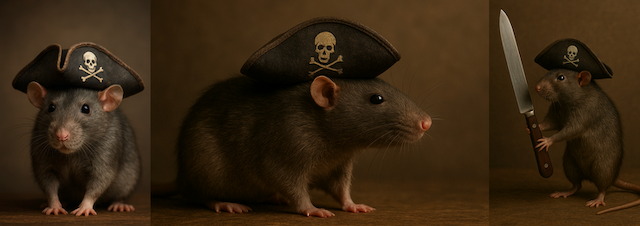
In honor of one of the novel’s
characters, I asked ChatGPT to draw some realistic rats wearing pirate
hats. (Apparently those are the correct numbers of toes.
TIL!)
👍 review: Jeff VanderMeer’s
sci-fi/horror novel Annihilation
Confession: for a long time I judged this novel (negatively) by the
movie. Now that I’ve actually read listened to the book, I’m
interested to read more in the series. I don’t recommend the audio
version though—it’s got a hypnotic quality to it and I found my mind
continually wandering.
There are a couple clever bits here: one of the
time travelers accidentally taking over the body of a dog, and the
notion that a particular technology (MRI machines) might happen to serve
as anchor points for future time machines to connect to. The
story itself is just OK, and the time travel mechanics aren’t super
interesting. (What would it even mean for there to be a delay as the timeline readjusts to eliminate
paradoxes? Is there some sort of meta time-dimension along which changes
to the block universe contained in the regular spacetime dimensions
occur?) Not the most memorable of Reynolds’s works.
I’m pretty
enamored with Clojure, but I’d probably have been more enamored with
this book if I’d read it at a different point in my life. The examples
often seemed motivated mainly by academic rather than practical concerns
and that wasn’t what I wanted right now. Nevertheless, the book is
packed with good information about the language. I appreciated the
breadth of coverage and attention to subtleties.
Drinking game: take a shot every time Kagan uses the phrase “But
for all that…” You’ll be unconscious in no time! Or: take a shot
every time he mentions an issue only to immediately say he’s not going
to get into that issue.
But for all that, I find Kagan’s writing quite endearing. I’m just
skeptical of his arguments.
I’ve written
before about the notion of reflective equilibrium: how our
intuitions about concrete cases and our intuitions about various
abstract principles put pressure on each other in a process of perpetual
refinement. I think people fall along a spectrum regarding which of
those directions they’re more sensitive to pressure from. Some of us are
more willing to revise our concrete judgments to make them fit into a
more compelling unified theory; others are more willing to gerrymander
the theory to accommodate more of their initial judgments. I feel like
this book falls too far along the latter end of that spectrum. It works
hard to come up with a theory whose prescriptions about when to treat
humans and various animals alike or different line up closely (not
perfectly) with common-sense opinion. I think this adds many
complications to the theory that would seem arbitrary if you weren’t
trying to reach specific preordained conclusions.
For example, consider what Kagan calls “modal personhood”:
Consider, for example, a 20 year old human who suffered irreparable
brain damage as an infant, so that she never became a person, but
remains, instead, at the cognitive level of a four month old. This
individual does not have the potential to become a person,
since there is nothing that we could do now for her that would allow her
to become one. But for all that, it is still the case that she could
have been a person (now), had the accident not occurred when she
was a baby. (p. 137)
Kagan thinks this might mean the human in question has higher moral
status than a nonhuman with equivalent capacities (assuming the nonhuman
doesn’t also have a comparable degree of modal personhood). But the idea
that modal personhood has ethical significance sounds pretty implausible
to me on its face, and our natural tendency to care more about the human
in this scenario seems easily explained in other ways: we just have a
bias toward our own species, or it’s easier for us to empathize with
modal persons, or we’re taking into account the impact on the human’s
family members, etc.
Kagan also discusses the notion of “modal doghood” which I think
would make a great album title.
By writing the above sentence, have I increased the modal
albumtitlehood of the phrase “modal doghood”?
No. Kagan distinguishes “potential” from “modal” whateverhood. Since
it remains possible that one of you will one day release a record titled
Modal Doghood, it would be more accurate to claim I’ve
increased the potential albumtitlehood of that phrase. Now go
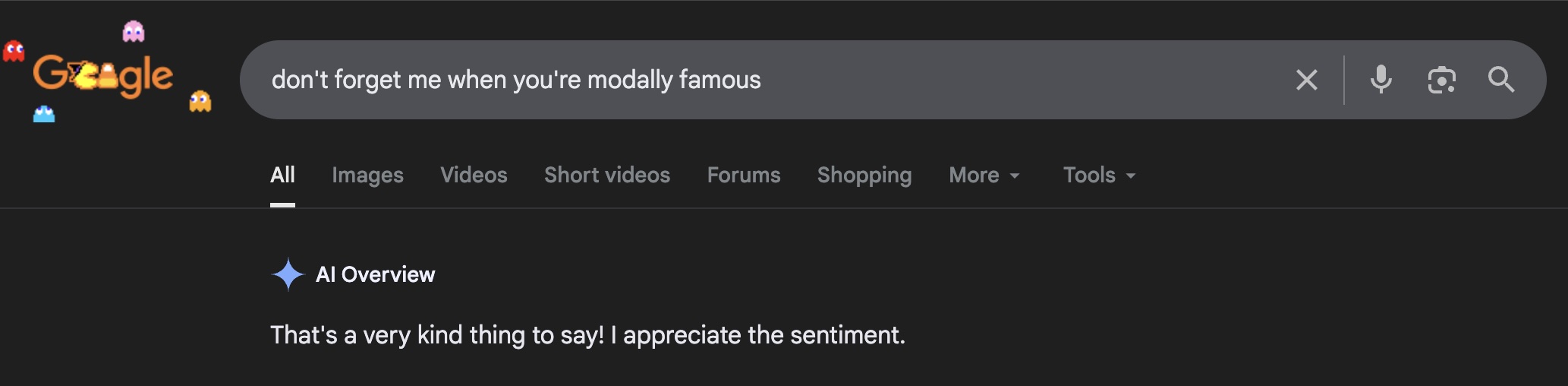
get to work on it! And don’t forget me when you’re modally famous!
idk what I expected from
this
The point of the book is to argue that there is a hierarchy of moral
status, so that for example the same kind and quantity of suffering
matters more (in itself, not in virtue of any differing consequences it
may have) when it happens to certain creatures (like ordinary humans)
than others (like ordinary insects). I remain entirely unconvinced, but
Kagan does raise some interesting points along the way.
In section 4.4 he discusses whether the principle
of equal consideration of interests rules out hierarchical views
like the one he’s defending. You’d expect it to, but he argues it
doesn’t “if we interpret the principle…as requiring only that we give
equal weight to interests that are similar with regard to all morally
relevant characteristics” (p. 106), since
belonging to beings of differing moral status might constitute a
relevant difference in otherwise similar interests. On the other hand,
if “the principle is to be understood as requiring us to give equal
weight to any two interests that are similar qua interests—that
is, that are similar with regard to the features of the interest that
make it have a bearing on one’s welfare” (p. 106), it will rule out Kagan’s view. He argues
that “so construed the principle does little more than beg the
question.”(p. 106) I’m more interested in his
claim that this version of the principle is also incompatible with any
ethical system that assigns intrinsic importance to questions of
distribution:
Indeed, it is worth noting that no one sympathetic to our
distributive principles can accept the principle under its second
interpretation. For if interests that have the same impact on welfare
must be given the same weight in our moral deliberations, then it is
[sic] must be irrelevant to ask whether a given boost in
well-being would go to someone who is worse off than others. We cannot
legitimately hold that it will do more good to give the increase to
someone who is worse off, rather than give an increase of the same
amount to someone who is better off. Yet these are exactly the sorts of
considerations that anyone drawn to egalitarianism will think relevant
in assessing where a given increase in well-being will do the most good.
Thus, despite the similarity in names, anyone who accepts an egalitarian
distributive principle must reject the principle of equal consideration
of interests, when it is understood in this second way. (p. 107)
I need to think about that a bit more.
Near the end of the book Kagan discusses “the problem of normal
variation”: if differences in moral status exist and are rooted in
differences in the degree to which different beings have various
capacities, wouldn’t that (disturbingly) imply some humans have higher
moral status than other humans, since e.g. our cognitive abilities vary
from individual to individual? One response Kagan considers is that
moral status may be determined according to a “step function”: status
increases abruptly when capacities cross certain thresholds, but is
constant between those thresholds. That sounds like exactly the sort of
theory-gerrymandering I complained about above, but Kagan has an
interesting strategy for justifying it: he appeals to the need for our
ethical systems to be practical. Humans aren’t psychologically
equipped to continually sort individuals into very subtle gradations of
status on a case-by-case basis, so a practical system—he suggests—needs
to give us just a few categories and we need to generally be able to
tell easily which category any given creature falls into. (He initially
presents this within the framework of rule consequentialism, but argues
other ethical theories can make the same move.)
In this future, when someone sustains a fatal injury, they aren’t
buried—they’re kept preserved in cold pac at a “moratorium”, existing in
a state of “half-life” from which they can be occasionally warmed up for
(audio-only) communication with the world of the living. This
communication must be used sparingly, as their remaining lifespan ticks
away with every moment of contact.
That’s a cool premise, but it’s the only thing I really liked about
the book. The prose is enjoyable enough (and Anthony Heald does a good
job narrating) but the characters are mostly flat and unlikable and much
of the story feels like someone recounting a nonsensical dream.
I was looking at this author’s blog and, because I just recently
wrote about how writing negative reviews gives me an itchy
conscience, it caught my attention that she’s expressed frustration
about being
expected to ignore one- and two-star reviews on Goodreads without
responding to them. (I think it’s totally fair for an author to
respond. I also think a lot of extreme reviews may really have more to
do with the reviewer’s desire for attention than with the book they’re
reviewing. In those cases, to say they’re using the book “as a public
punching bag” is especially apt: they wanted something they
could bash and decided the book could be put to that use.) She also
suggests, quite plausibly, that bad reviews may reflect
“a reader / book mismatch” where “the reader is fine, the book is
fine - but this is not the book the reader was meant to read at this
time or maybe even ever.” (She says not to read her previous book if you
“loved Station Eleven but hated House of Leaves”, so, I won’t. (OK, I
didn’t actually hate House of Leaves, I just thought the tedium
overshadowed the good writing, but it’s more fun to take an extreme
stance!))
I think I was, indeed, mismatched with most of the stories in this
collection. They generally seem to be more metaphors than
stories per se, and the
main theme is asexuality; though some things were clear, I often
felt I was missing the right experiences or background to be sure
exactly what message the story wanted to convey.
I really liked two of the stories though:
“Long May My Land be Bright”, in which the US deals with its
political division by having a different president on odd- and
even-numbered days
“LK32C”, about a mother’s relationship to her violent,
uncommunicative, inward-focused son